
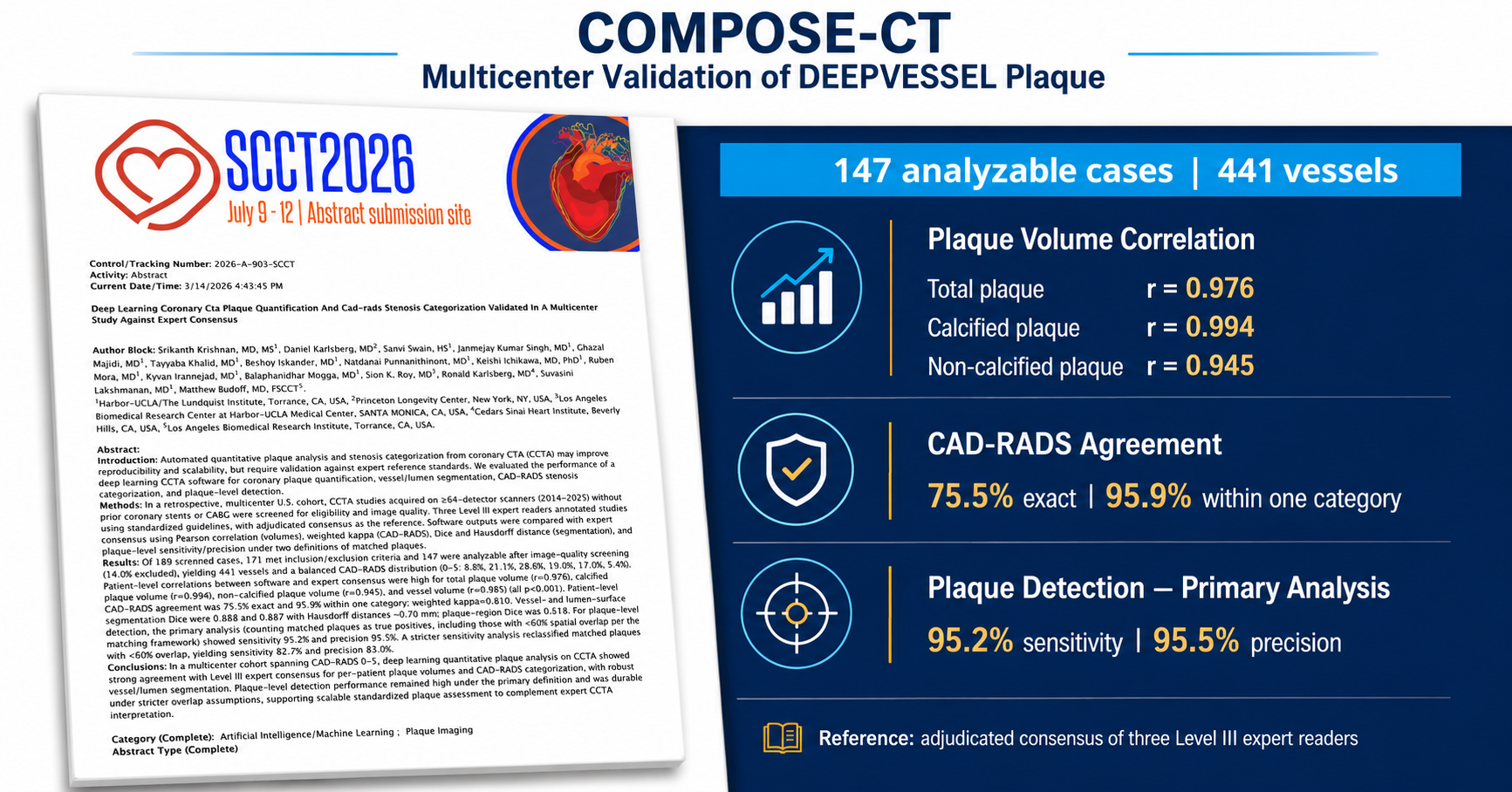
A multicenter U.S. study presented at SCCT 2026 demonstrated strong agreement between DEEPVESSEL Plaque and Level III expert consensus for quantitative coronary plaque assessment and CAD-RADS® stenosis categorization.
The COMPOSE-CT study included 147 analyzable coronary CT angiography cases, representing 441 vessels and the full range of CAD-RADS categories. Three Level III expert readers evaluated the studies, with adjudicated consensus serving as the reference standard.
Key findings included:
- Total plaque volume: r = 0.976
- Calcified plaque volume: r = 0.994
- Non-calcified plaque volume: r = 0.945
- Exact CAD-RADS agreement: 75.5%
- CAD-RADS agreement within one category: 95.9%
- Weighted kappa for CAD-RADS: 0.810
- Plaque-detection sensitivity and precision: 95.2% and 95.5% in the primary analysis
The software also demonstrated robust vessel and lumen segmentation. Under a stricter plaque-matching analysis, sensitivity was 82.7% and precision was 83.0%.
These results demonstrate strong agreement with expert consensus and support the use of standardized, scalable AI-assisted plaque assessment to complement expert CCTA interpretation. The COMPOSE-CT evidence forms an important part of the clinical validation supporting FDA-cleared DEEPVESSEL Plaque.
Keya Medical gratefully acknowledges Dr. Matthew Budoff and the research team at The Lundquist Institute, along with lead author Dr. Srikanth Krishnan, Dr. Daniel Karlsberg, and all participating investigators, for their leadership and contributions to this multicenter study.
Reference standard: adjudicated consensus of three Level III expert readers. The study did not use an independent modality such as IVUS or histology.
Links to publication:
